Unified App for Publishers: Why Media Houses Are Moving Beyond Separate News & E-Paper Apps
When digital publishing continues to evolve, many publishers are asking the same question: Do we really need so many separate digital products?
For many years, it has been common to split the digital reading experience across multiple platforms – one app for e-paper editions, another for live web news, and separate tools for podcasts, newsletters, or archives. Each product made sense on its own. Together, they often created fragmentation.
Heading into 2026, more publishers are rethinking this setup. Not because consolidation is suddenly trendy, but because complexity has become expensive – both for organizations and for readers.
Instead, a unified app is emerging as a long-term foundation: a shared workspace where different content types, workflows, and business models can coexist and evolve over time. This is exactly where Prenly comes in – as a unifying platform for the entire digital publishing operation.
When content lives in separate systems:
A unified app doesn’t mean “one format fits all.” It means one place where different formats work together.
Multiple apps mean:
With Prenly:
For publishers and media houses, this means having a unified app that adapts as their publishing model evolves – not one that needs to be replaced.
A unified app:
That shift is what makes a unified app not just a technical decision – but a strategic one.
Contact us or book a free demo to see how publishers use Prenly to create a unified app experience – fully tailored to their workflows and goals.
Heading into 2026, more publishers are rethinking this setup. Not because consolidation is suddenly trendy, but because complexity has become expensive – both for organizations and for readers.
Instead, a unified app is emerging as a long-term foundation: a shared workspace where different content types, workflows, and business models can coexist and evolve over time. This is exactly where Prenly comes in – as a unifying platform for the entire digital publishing operation.
Publishing has outgrown channel-based thinking
Most publishers don’t struggle with content creation. The real challenge lies in distribution, maintenance, and coherence.When content lives in separate systems:
- editorial workflows become fragmented
- readers must learn multiple experiences
- development and maintenance costs increase
- it becomes harder to build habits and loyalty
A unified app doesn’t mean “one format fits all.” It means one place where different formats work together.
What publishers really mean by a “unified app”
A unified app is not just a container for content. It is a digital product where:- e-paper editions and web news coexist
- articles, audio, podcasts, and special content live side by side
- access rules, subscriptions, and permissions are consistent
- readers move seamlessly between formats without friction
Why readers benefit from a unified solution
From a reader’s perspective, fragmentation creates unnecessary friction.Multiple apps mean:
- multiple logins
- different navigation patterns
- inconsistent reading experiences
- start with breaking news and continue into a full edition
- switch between article view and classic PDF layout
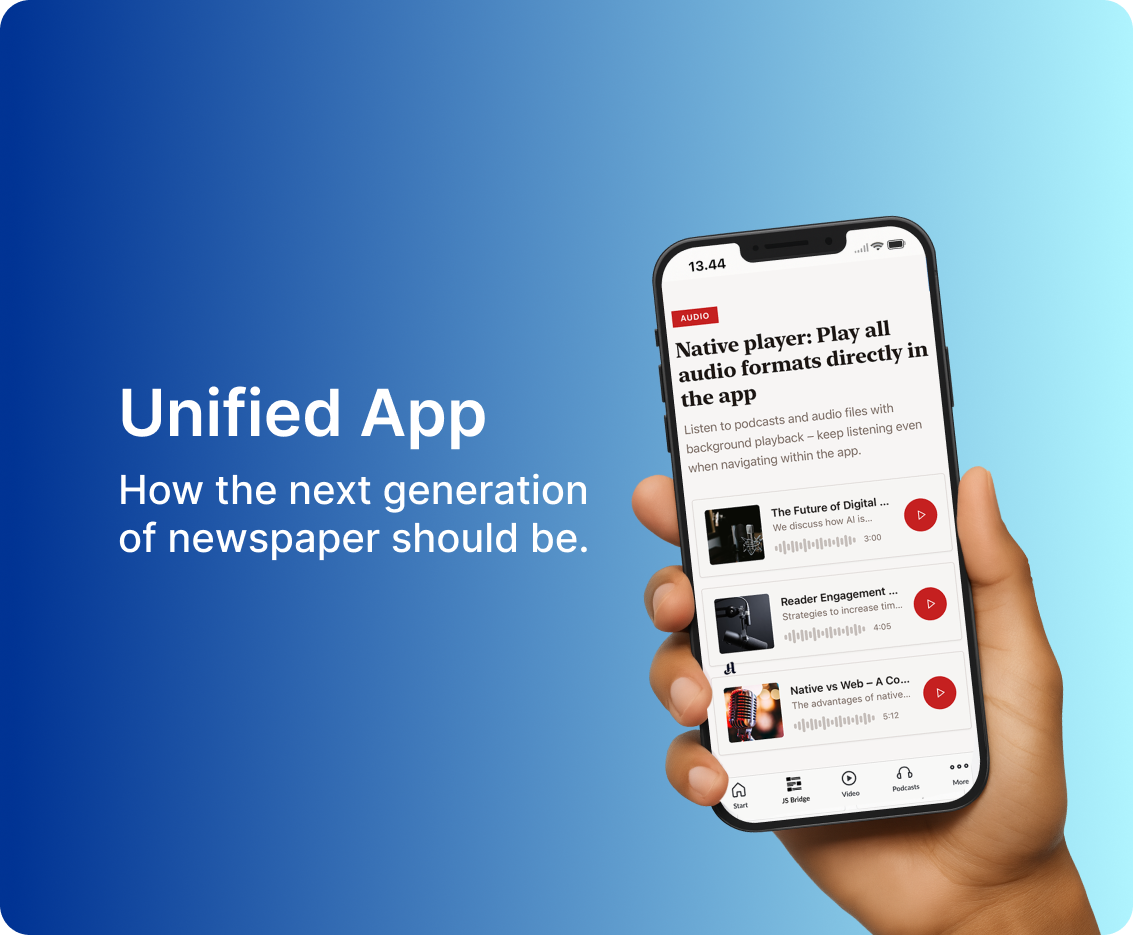
- listen to content via text-to-speech or podcasts
- save content and return later – all in one place
Why publishers benefit even more
For editorial and product teams, unification is not just a UX improvement – it’s a workflow improvement. A unified app allows publishers to:- manage content, layout, and promotion from a single tool
- avoid duplicating work across multiple platforms
- introduce new content types without launching new products
- evolve the experience over time without heavy development cycles
- editorial quality
- audience value
- long-term strategy
One app doesn’t mean one title
A common misconception is that a unified app limits flexibility. In practice, the opposite is true. Many publishers today operate:- multiple titles
- regional and national editions
- collaborations or partnerships
- niche or temporary publications
- a shared newsstand
- flexible access rules
- editorial control over what is highlighted – and when
Where Prenly fits into a unified app strategy
Prenly is built on the idea that publishing is a workflow – not a collection of isolated channels.With Prenly:
- e-paper editions and web content live in the same app
- publishers control structure, content, and design via the App Manager
- updates are reflected instantly across iOS, Android, and web
- access, subscriptions, and analytics are handled consistently
For publishers and media houses, this means having a unified app that adapts as their publishing model evolves – not one that needs to be replaced.
A more sustainable way forward
The strongest signal going into 2026 is not about new features or formats. It’s about how publishing teams want to work.A unified app:
- reduces operational complexity
- strengthens the reader relationship
- supports long-term digital strategy
That shift is what makes a unified app not just a technical decision – but a strategic one.
Interested in seeing how this works in practice?
If you want to explore how e-paper, web news, and other content types can live in one unified app, we’d be happy to show you how.Contact us or book a free demo to see how publishers use Prenly to create a unified app experience – fully tailored to their workflows and goals.
Prenly Workspace
Prenly Workspace is the tool for publishers, editorial teams, and media organizations. Here you create articles, add text and media, organize content into sections and categories, and publish everything easily when you’re ready.